
Dealing with Catastrophic Failure: What Washington and Greene Can Teach Us About Leadership
What Ken Burns Missed in Episode Three, Pt. 3

One can often learn more from their failures than successes. That was certainly the case for Nathanael Greene during the Revolution.
In what is now a little-known story arc, the battle for Fort Washington was a turning point in the relationship between George Washington and his inexperienced subordinate, Greene.
If what followed had gone differently, the Revolution might not have ended favorably. Fortunately, it didn’t, and years later Greene became the strategist who wore down the British army in the Southern Campaign and set the stage for the decisive blow at Yorktown.
How those two reached that endpoint offers some of the best leadership lessons from this era of American history. But on a cold fall morning in 1776, Greene was a completely untested leader.
On paper, he was a “major general,” having been promoted just 100 days earlier on the strength of his self-taught historical military knowledge and political connections. But the 34-year-old Quaker former ironmonger from Rhode Island hadn’t yet led men in combat.
And he was about to see the results of the 22 days of effort he’d put into overseeing the fort’s defenses.
Spoiler #1: It did not go well.
Spoiler #2: None of this was covered by Ken Burns.
Greene’s Worst Day
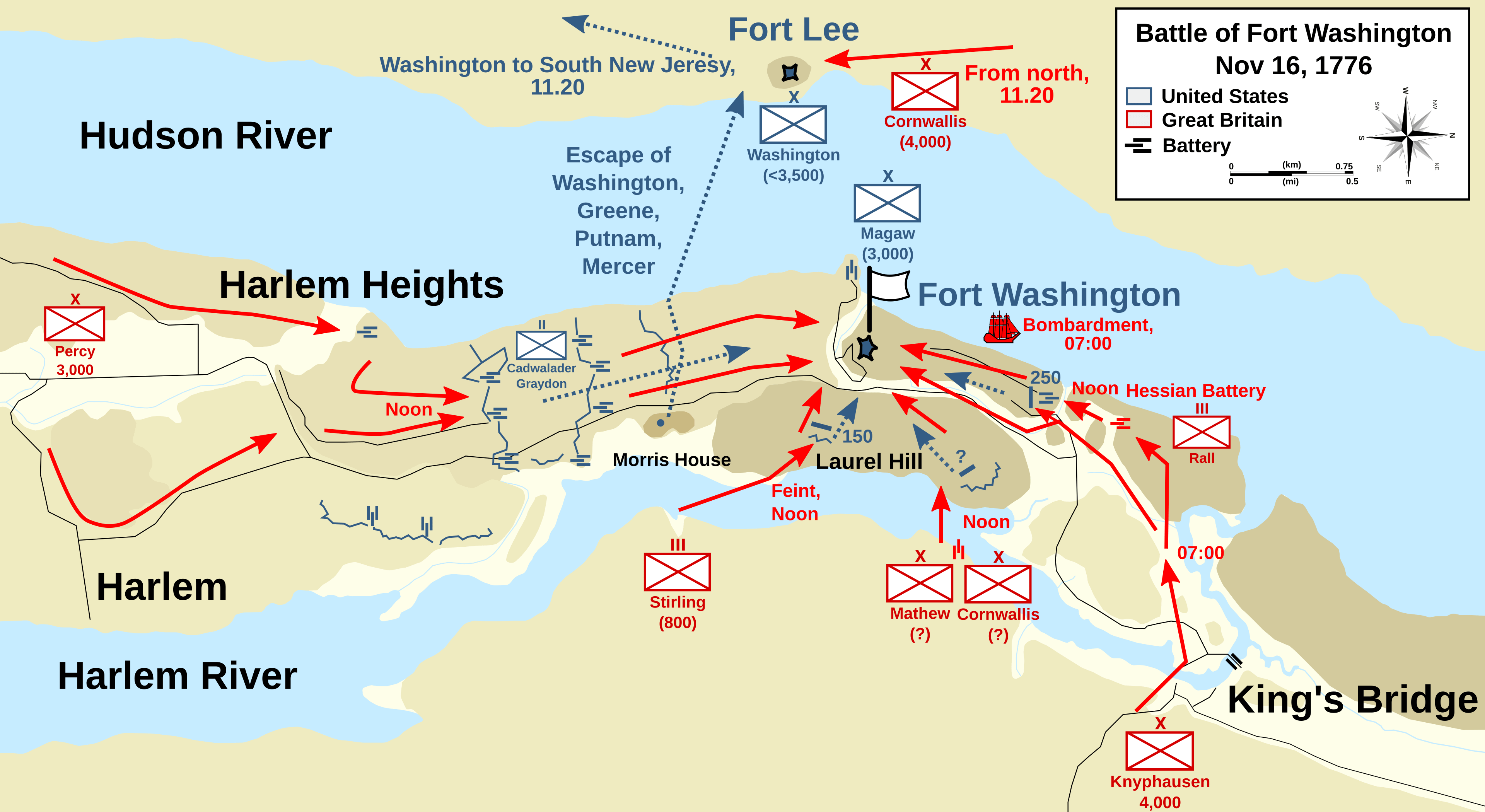
It’s not an overstatement to suggest that the morning of November 16, 1776, was likely the worst of Greene’s life. As he stood on a hill on Manhattan behind the Fort’s second defensive line, he watched as British and Hessian forces drove back his men from three directions at once.
Nearly 3,000 patriots were under his command. In the weeks leading up to the attack, he’d assured Washington the fort’s defenses were progressing well and that it could hold, relying on the garrison commander, Robert Magaw’s assurances. They’d held off a small British probing force and damaged some passing British ships in the previous ten days, giving the two inexperienced leaders a false sense of security.
In other words, Greene communicated up the chain of command the way many young leaders do when they want the confidence of their boss: “Don’t worry, I’ve got this.”
Washington had been skeptical but had deferred to his subordinates’ assessment.
This was despite Washington knowing the Continental Army lacked the trained engineers needed to complete the fortifications. The Army’s only competent engineer, Rufus Putnam, had requested help from the Continental Congress three weeks prior to Greene taking over and was rejected.
Putnam, so frustrated by the response, took another commission back in Massachusetts. In other words, he saw a train wreck coming, and when Congress refused to help him, he had effectively resigned.
Greene was the cleanup crew.
Washington, perhaps impressed by Greene’s encyclopedic military knowledge, might have hoped he could pull off a miracle. Or perhaps he was more concerned about the political implications of running from another fight.
Whatever influenced his ultimate deferral, it quickly became apparent that the fort, in fact, would not hold. Everyone on the hillside with him on that morning could see it.
Standing next to Greene and Washington were Israel Putnam (Rufus’ cousin) and Hugh Mercer. These were four of the most senior officers in the Continental Army, stranded inside a battle they could not affect, as it was becoming painfully clear that the fort’s fortifications were a major problem.
But the disposition was already made, and the enemy was advancing. No boats were available to transport the 3,000 Continentals to safety.
Putnam and Mercer urged Washington to leave. Greene offered to stay.
Washington insisted they all leave together. Thirty minutes later, the four generals were back across the Hudson at Fort Lee, watching from the New Jersey shore.
Greene wrote about it the next day in a letter to his closest friend, Henry Knox. “There we all stood in a very awkward situation,” he wrote. Then, a few sentences later, the line that defined the moment: “I am mad, vext, sick, and sorry. Never did I need the consoling voice of a friend more than now.”
He went on: “I was afraid of the fort. The Redou[b]t you and I advised was not done.”
He knew exactly what was wrong and what it would cost.
What We Have Here is A Failure to Communicate…
Fort Washington was not the beginning of this story. It was the second act of a failure that began at Long Island in August 1776, when Greene was the officer who knew the terrain best and wasn’t available when it mattered.
Greene had spent weeks preparing the fortifications in Brooklyn Heights. He knew every pass through the Heights of Guan, every approach the British might use.
Then, on August 15, he fell gravely ill. Washington replaced him, first with John Sullivan, then with Israel Putnam - two officers with more combat experience than Greene but zero familiarity with the ground he had studied for months.
What followed was a disaster. The British found the Jamaica Pass, a little-known route on the far eastern flank, guarded by exactly five militia officers on horseback. Ten thousand British troops walked through it in the night and flanked the entire American position from behind. The result was the largest single American defeat of the war.
Three days later, Greene - still recovering - wrote that he “could have given the commanding general a good deal of necessary information.” The restraint in that sentence barely conceals what he was really saying: I knew where the weakness was. The people who replaced me didn’t.
But Greene had also not communicated any vulnerabilities before he left the field. The knowledge disappeared with him when he went to bed with a fever, and that was his responsibility.
Fort Washington repeated the pattern. Except this time, Greene was present.
He had a private fear about the fort’s incomplete defenses. He and Knox had recommended a specific redoubt that was never built. And yet in every official communication about whether the position could hold, he presented the optimistic case - men in good spirits, situation under control - and kept the engineering fear to himself.
Why? Greene was 34 and likely eager to prove himself in his first real independent command. Illness had stopped his opportunity for command on Long Island.
Fort Washington was his second chance to prove he could both prepare and defend a position. He had publicly, repeatedly staked his professional reputation and honor on holding it.
To reverse course could mean losing further credibility. He leaned into hope - into Colonel Robert Magaw, the garrison’s commander, telling him everything would be fine - because he didn’t yet have the experience to know when to trust his gut and what he had read over the man standing in front of him.
The combined British-Hessian assault force of 8,000 men grossly outnumbered the fort’s 3,000 defenders. Nonetheless, the Americans enjoyed initial success, inflicting heavy casualties and repulsing two Hessian charges.
That success did not last. The tide began to turn when 3,000 men under British General Hugh Percy punched through the outer defensive lines to the fort’s south.
Nearly 3,000 patriots paid dearly for that decision. After taking about 150 casualties, Magaw surrendered 2,800 men to the British in a disastrous defeat.
Washington Leads, Sort of…
Washington’s initial public response - his letter to Congress on November 16 - was carefully framed. He relayed that he had given Greene discretionary authority; Greene had exercised it. The result followed. The letter was technically accurate. But politically protective of his own interests.
His private letter to his brother was more raw: the fort had been held “contrary to my Wishes and opinion,” and its loss was “to my great grief.”
What he didn’t do in his letters to Congress or to his brother was take ownership of fully delegating the decision to Greene, despite Greene’s clear inexperience. Or acknowledge that he didn’t trust or act on his own instincts.
The reality was that Washington was still a bit of a novice himself. More experienced than Greene, certainly. But many years had passed since he was in active service, and even then he wasn’t required to lead men the way he was now.
So while he didn’t quite throw Greene under the bus, he didn’t defend the lack of resources Greene was working with, nor act like a commander in chief.
To his credit, he didn’t relieve Greene either. He just shortened the leash and brought him under his direct command.
Six weeks after Fort Washington, Washington put Greene in command of one of the two columns crossing the Delaware on Christmas night to attack Trenton. Not a rehabilitative sideshow - Washington’s own column. The message to the army was impossible to miss: Fort Washington was a setback, not a verdict.
What followed was a careful calibration that most leaders never manage. Washington gave Greene responsibilities that grew in stages. Trenton. Princeton. Brandywine, where Greene’s division made a desperate four-mile forced march to plug a collapsing line and likely saved the army from destruction. At each stage, a little more rope, a little more independence, a little more trust. The leash grew longer as the judgment proved sound.
When, in the winter of 1777-78, a faction - the Conway Cabal - tried to replace Washington with Horatio Gates, Greene sided with Washington. Publicly, loudly, and at personal cost.
Greene became a political target precisely because of his closeness to the commander-in-chief. He accepted that. The loyalty Washington had invested in Greene, Greene returned when Washington needed it most.